
Oyster Bay City Directory Holdings
Oyster Bay city directory research rests on a small set of confirmed leads, not a proven complete run. The New York Genealogical & Biographical Society's Nassau guide identifies Nassau city directories for 1868–1869 and 1909–1913. The Oyster Bay-East Norwich Public Library provides directory material through HeritageQuest, but its public pages do not list every title, publisher, or annual volume available for the Town. That distinction matters: a directory label on a database is a lead, not proof that a particular Oyster Bay address appears in a particular year.
| Collection | Years | Where Held | Access |
|---|---|---|---|
| Nassau city-directory leads | 1868–1869; 1909–1913 | NYG&B guide and local history repositories | Confirm exact title, publisher, and local holdings with staff. |
| HeritageQuest directory material | Local run not published | Oyster Bay-East Norwich Public Library | Library database access; ask staff for a title-by-title check. |
| Federal census images | 1790–1940 advertised; public release through 1950 | HeritageQuest and archival databases | Household snapshots, not annual residence proof. |
| Historical newspaper collections | Newsday 1940–1985; New York Times 1851–2019 | Library databases, microfilm, and ProQuest | Use notices and events to test a directory clue. |
| Oyster Bay Historical Society research | Town records 1653–1878; holdings 1680–present | Earle-Wightman House collections | Inquiry service and on-site historical research. |
The confirmed years are useful starting points, but the gaps remain real. No source reviewed establishes a first or last printed Oyster Bay directory, a complete reverse-directory chronology, or a full publisher list. Ask the library before planning a year-by-year run.
Oyster Bay Directory Years We Can Verify
The two Nassau date clusters, 1868–1869 and 1909–1913, should be treated as research anchors. Search a name in the available volume, capture the printed year and page, then compare the entry to a census, deed, newspaper notice, or vital record. The Town of Oyster Bay includes many community and postal names, so a failed search under one place name should prompt a check of the surname and street rather than an assumption that the person was absent.
Directory history is fragmentary online. HeritageQuest advertises city-directory material, yet does not publish a complete Oyster Bay list. Neither the library pages nor the county guide supports naming a publisher or promising a reverse volume for a missing year. Preserve that uncertainty in research notes, especially when an address has a village, hamlet, or mailing-city label.
Note: A volume can document a reported connection at publication time, not title to property or a person's current residence.
Oyster Bay Directory Timeline
The confirmed historical points form a timeline of sources, not a continuous publication history. It combines the Town's early-record survival, the county directory leads, and the record-keeping change that makes later property research look different from earlier Town research.
- 1653 onward: Oyster Bay Historical Society research can reach Town records from 1653–1878.
- 1847–1849: Oyster Bay preserved a local birth, marriage, and death book from the short-lived state experiment.
- 1868–1869: NYG&B identifies a Nassau city-directory lead for these years.
- 1899: Nassau County was created from Queens County, while older Town sources remained essential.
- 1909–1913: NYG&B identifies a second Nassau city-directory lead.
- July 1992: Nassau's property index moved to an electronic database, a later layer for verifying land records.
No source reviewed supplies a complete publisher succession, reverse-directory chronology, or final printed year. The timeline should guide a repository request, not fill those missing details.
Oyster Bay Local History Sources
The Oyster Bay-East Norwich Public Library research service combines several tools that make a thin city-directory lead more useful. HeritageQuest includes census images, local and family histories, tax lists, directories, and probate material. The library also lists Historic Map Works, New York Heritage, historical New York Times, historical Newsday, Fold3, and other databases. Ancestry Library Edition is specifically in-library access only. These sources are best used to test a date, address, or family connection found in a volume.
The library's Local History and Theodore Roosevelt Collections include local materials, newspaper microfilm, a microfilm reader, and staff assistance. Check the live hours and copying information before an on-site visit. Historical Newsday microfilm is identified at 1973 and the general-services page identifies New York Times microfilm for 1966, while the research page lists broader licensed digital coverage. The difference between microfilm holdings and database coverage is another reason to record the exact source used.
Reading an Oyster Bay City Directory Entry
A traditional city directory may arrange names alphabetically, by address, or by telephone. The Library of Congress notes that entries can include a surname and given name, spouse or widow notation, occupation, employer, address, and institutional affiliations. What appears on the page depends on the publisher and year. No locally scanned Oyster Bay sample entry was available in the reviewed public pages, so the fields below are an inventory to capture from a real volume, not a claim about every local edition.
| Printed year and volume | Identifies the edition being cited and helps separate one annual entry from another. |
|---|---|
| Page and spelling | Preserve the page, initials, punctuation, and variant spelling exactly as printed. |
| Name and family notation | May show a spouse, widow notation, or only the named householder, depending on the volume. |
| Address | Records a reported location in that edition; compare it with period street names and parcel records. |
| Work and affiliations | Occupation, employer, telephone, or institutional details may appear, but are not universal fields. |
| Owner or renter mark | Record an abbreviation only if that volume defines it in its own key. |
- Criss-cross directory
- A reverse section arranged by address that can point from a street number to the listed occupant or householder.
- Householder index
- An alphabetical or address-based finding aid that may identify the person listed for a household, rather than every occupant.
- Abbreviation key
- The volume's own explanation of shortened terms or symbols. Photograph or transcribe it before interpreting a mark.
Oyster Bay Reverse Directory Searching
For an old address, a reverse or criss-cross directory is the efficient first check when one is available. Normalize the house number and street name, look for the address in the reverse section, and record the listed name and page. Then search the alphabetical section for that name. Comparing the two entries can supply spouse notation, occupation, employer, or a nearby address when the volume includes those details.
Do not assume a reverse run exists just because city-directory material is available through HeritageQuest. The local reverse inventory has not been published. Where a reverse volume cannot be confirmed, use the alphabetical volume, census household, deed description, and local newspaper material instead. Current parcel work belongs in the Oyster Bay street directory, which follows address-keyed assessment and land records rather than rebuilding the historical shelf.
Oyster Bay Census and City Directories
Census images provide a household snapshot while a city directory can place a reported name between census years. HeritageQuest advertises federal census images from 1790–1940, and the 72-year release rule makes 1950 the latest generally public federal census as of 2026. Pair the nearest census with the directory year on either side. A move may appear in a directory before a deed is recorded, and a census may capture a family after an earlier move.
- Start with a full name, a known address, and one dated directory or census record.
- Search backward and forward only in directory years that staff or a database title list confirms.
- Compare the address, spouse notation, and age or household composition in the nearest census.
- Use deeds, notices, permits, or vital records to test a move, death, or change in ownership.
- Keep the repository, volume, page, and date with every conclusion.
A missing name may mean a move, a spelling variation, a different listing choice, or a gap in the surviving run. It does not establish why the person disappeared.
Oyster Bay Historical Society Help
For a documented family or address question, the Oyster Bay Historical Society genealogy service offers a human-assisted path. At the Earle-Wightman House, staff can check Town Records 1653–1878, cemetery records, archival files, Marmaduke Earle marriage records, Henry B. Hoff's Long Island Source Records, and Dutch Congregation history. A basic inquiry is free and normally answered in two to three weeks. An extended search begins at $45, or $35 for members, and returns paper copies rather than electronic or fax results.
The Society accepts inquiries by phone, fax, email, or mail, and its form asks for a research question and work already done. That makes a narrow request stronger: give a name variant, place, time span, known record citation, and a clear question. It is not a bulk name service.
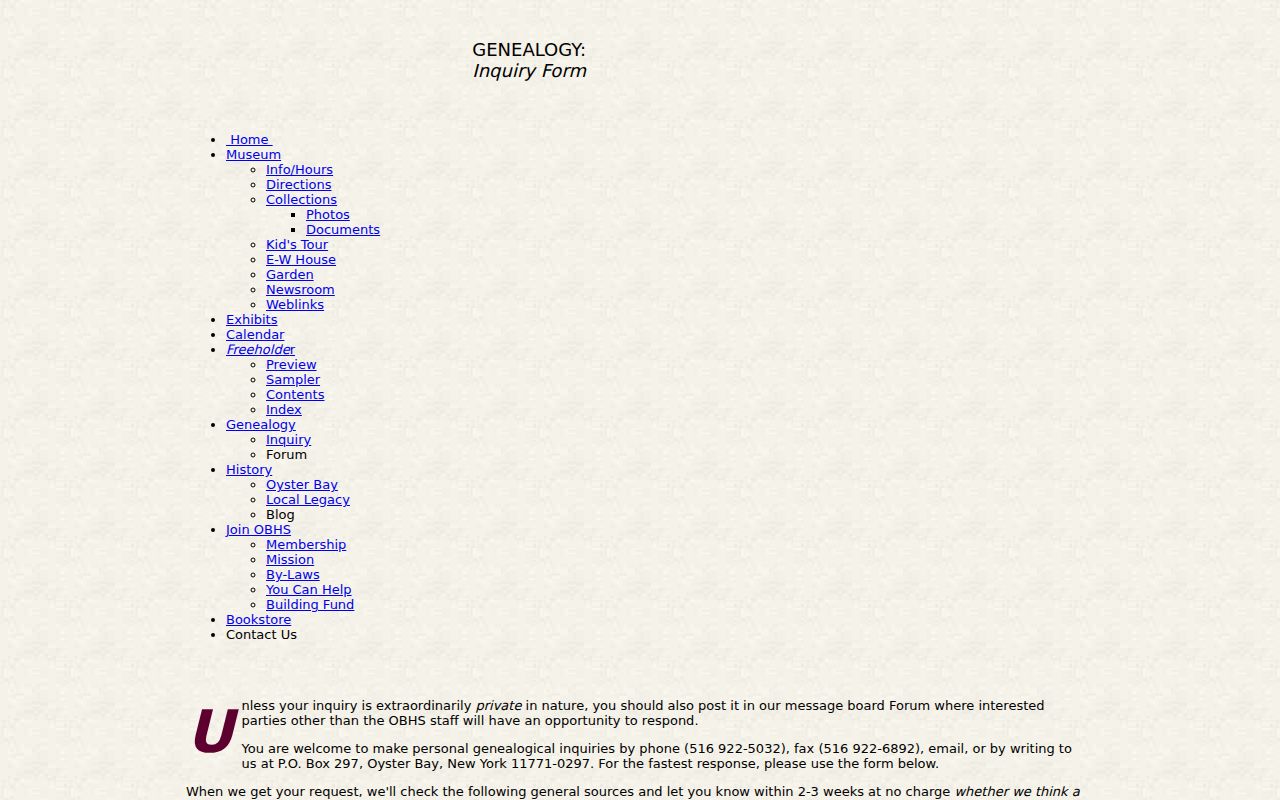
The Historical Society genealogy page shows the kind of bounded inquiry route available for Oyster Bay research.
The service is most valuable when a directory clue needs context from early Town, cemetery, church, or archival material that is not presented as a searchable resident list.
Oyster Bay Records Before Nassau County
Nassau County was created in 1899, while Town of Oyster Bay records reach much further back. The Town's 2025 1847–1849 Birth, Marriage & Death Records guide is a rare local survival from New York's short-lived early vital-record experiment. It lists 437 births, 117 marriages, and 285 deaths. The original entries can contain richer details than the printed name-and-date guide, including residence and, for deaths, age, occupation, marital status, national origin, and cause.
This is a useful family-history bridge when an early directory or census lead falls short. It does not prove that a person occupied a particular house, and it is not a substitute for a deed, census household, or later vital record. Written requests to the Town Historian can seek additional information by name and date without a stated charge.
Trace Families With Oyster Bay Directories
Family tracing works best when each city directory entry stays tied to its printed year and source. Start with the earliest confirmed appearance, follow only the available volumes, and mark address changes without treating every listing as a move. When a name vanishes, compare census records, a deed chain, newspapers, cemetery material, or an obituary lead. The resulting timeline is a set of dated evidence points, not a claim of continuous residence.
Use local history sources to separate people with the same surname. A spouse notation, street address, occupation, or repeated nearby household may distinguish them. For modern confirmation after a historical find, the Oyster Bay resident lookup explains current official record routes and their limits.
Note: Record the volume's spelling before normalizing it, because initials and historic place labels can be the key to the next source.