
Oyster Bay Resident Lookup Evidence
Each Oyster Bay resident lookup starts with a precise question. A current-registration question belongs with the state voter tool. A parcel question begins with the Nassau County Land Records Viewer, known as LRV, and then Nassau County Clerk, Land Records. An SBL is the Section, Block, and Lot identifier used to locate that parcel. A public case question belongs in the court systems. Historic relationships may require a registrar, an estate file, or a library collection. A record can establish a dated connection, but it does not turn a name hit into proof that a person now lives at a given address.
| Record | What It Confirms | Where | Access |
|---|---|---|---|
| LRV parcel record | A parcel, roll data, assessment context, and deed reference | Nassau County Land Records Viewer | Free address or SBL search; no public owner-name field was located. |
| Recorded land record | A conveyance party, legal description, and recording date | Nassau land-record search | Electronic database from July 1992; copies and older records use Clerk channels. |
| Voter registration | Current registration or polling information | New York Voter Registration Look-up | Individual lookup; protected addresses and identifiers are withheld. |
| Public court metadata | A public case connection and its displayed status | WebCivil Supreme / NYSCEF | Availability depends on court, case type, sealing, and e-filing status. |
| Vital or estate record | An event or estate relationship | Town Registrar / Surrogate's Court | Eligibility and case-specific limits apply. |
Start with the source that best fits the known fact. LRV accepts an address or SBL. The Clerk supplies the recorded land chain. A court case or license may distinguish a similarly named person, but neither is a current-address guarantee. Note: A person can be connected to a record without being a current Oyster Bay resident.
Oyster Bay Two-Anchor Checks
Use two anchors before treating a record as belonging to one person. An anchor is a fact that can be compared across independent records, such as a dated address and a middle initial, or a name and a unique entity. Common surnames, initials, married names, suffixes, and old street numbers create false matches. A tax-mailing address can be helpful, yet it remains a correspondence clue rather than a statement about occupancy.
- Write down the full name, likely spelling variants, a middle initial or suffix, and one time or place anchor.
- Use a known address or SBL in LRV. Preserve the situs address, tax-mailing address if displayed, and legal parcel description as separate facts.
- Check the name in a public court index or a relevant state affiliation record, then compare the county, date, and other identifying details.
- When both anchors agree, request the original from the custodian if a certified or complete record is required. If they conflict, leave the result unresolved.
A deed can provide a stronger parcel link than a street spelling. Search the current grantee and prior grantor through the Clerk's record trail, keeping the same SBL and legal description in view. For a whole named street rather than one person, use the Oyster Bay street directory workflow, which keeps the work address-based.
Oyster Bay Court Records Lookup
WebCivil Supreme is the main free party search for the relevant Supreme Court civil material. Its inspected screen offers Index Number, Name, Attorney Name, and Justice Name, plus party role, court selection, filing year, case status, future-appearance, sort-order, and HTML or PDF-output controls. A result may identify an index or case number, parties and roles, court, assigned justice, case type or status, and appearances. It is not the underlying pleading or a final judgment by itself.
| WebCivil field | Index number, name, attorney name, justice name, party role, court, year, status, future appearance, and output format. |
|---|---|
| NYSCEF name route | Party or attorney name type, business or organization name, first, middle, last, county, case type, and filing-date filters. |
| Result inventory | Index or case number, parties and roles, court, justice, case type or status, appearances, and available document links. |
| Critical limit | Sealed, matrimonial, juvenile, adoption, and much Family Court material is not ordinary public name-search material. |
NYSCEF's name-search screen provides the party, attorney, county, case-type, and date filters used for this record check.
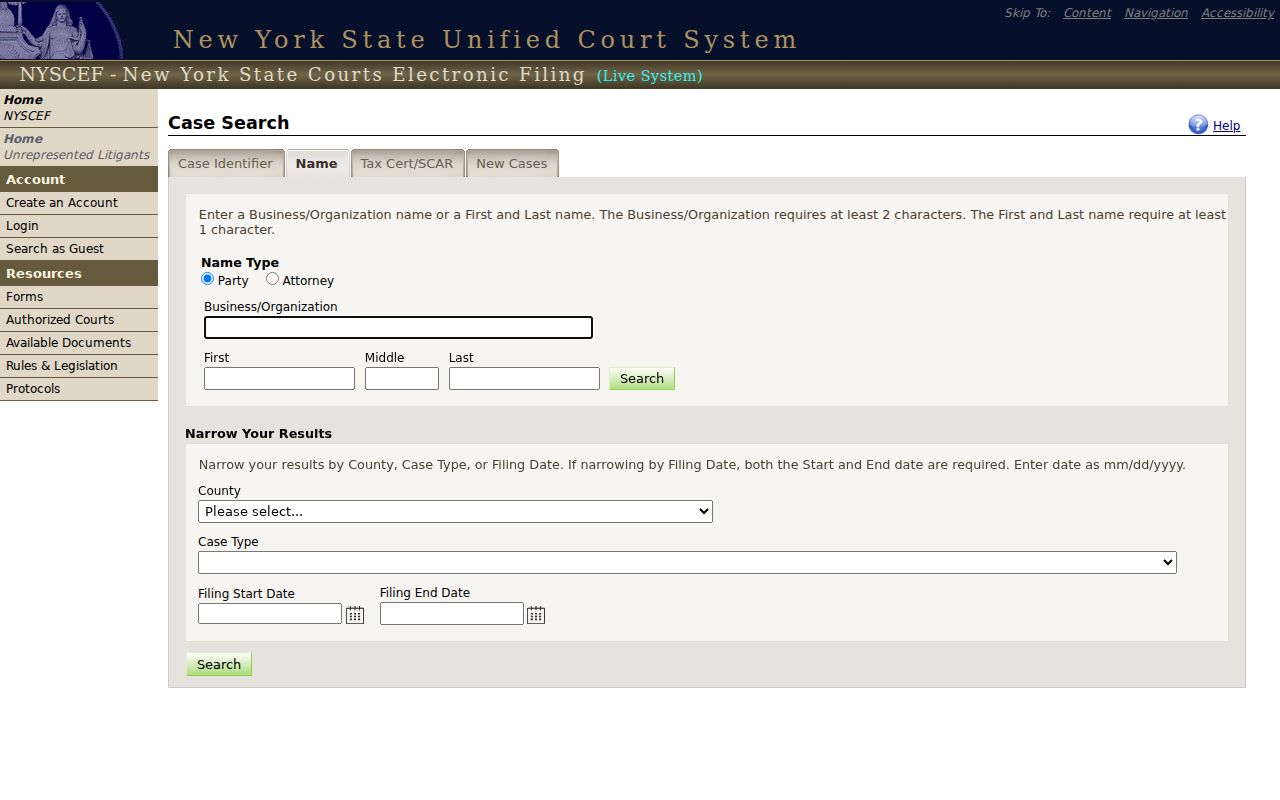
Use the displayed fields to narrow a name, then confirm whether the appropriate court and case type are involved before drawing any conclusion from a public result.
Oyster Bay Voter Lookup Limits
The New York Voter Registration Look-up is an individual current-status and polling-information tool, not an Oyster Bay resident list. The inspected form calls for county, last name, first name, date of birth, and ZIP, with instructions that also refer to address information. It requires a current browser with JavaScript and cookies. A result or non-match reflects what the state currently publishes, not every person at a parcel and not a history of where someone has lived.
The official voter lookup shows the individual-search form used for current registration and polling information.
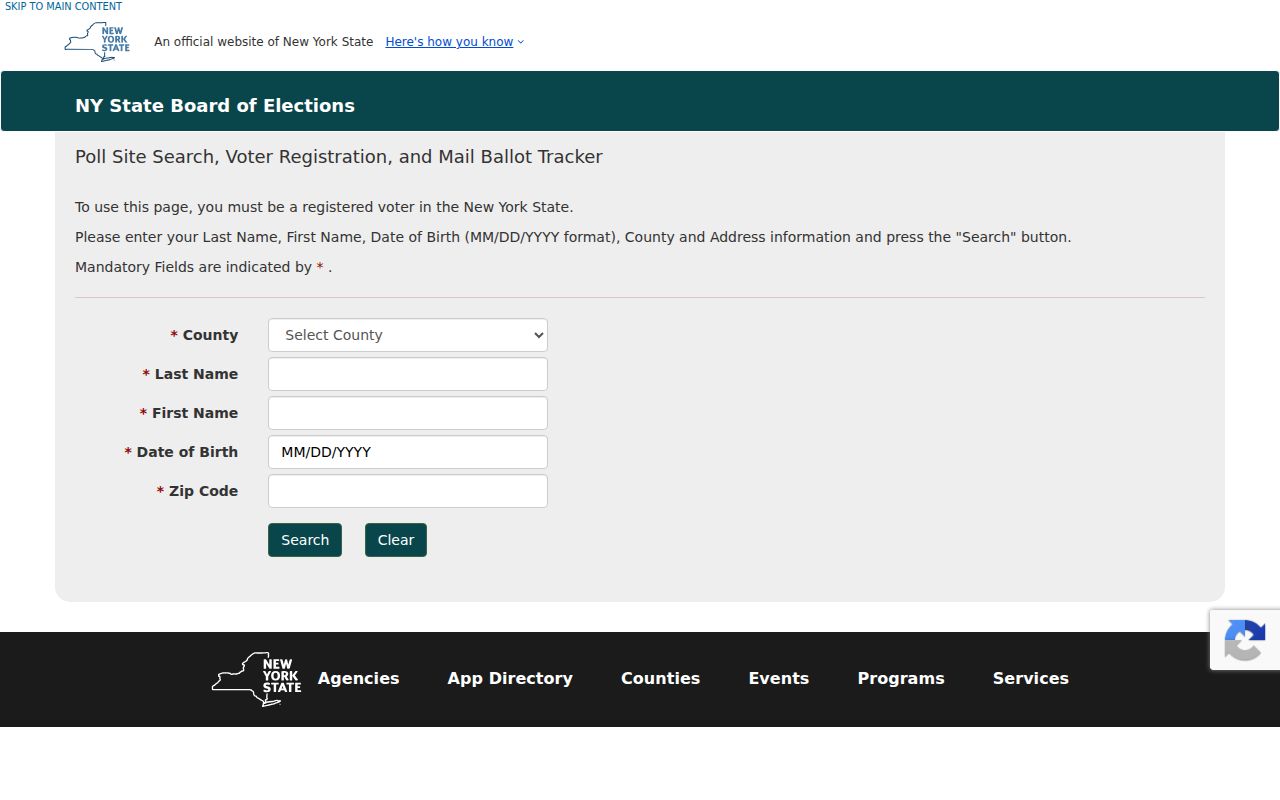
New York makes selected voter-file data public under Election Law, but statewide or multi-district requests require an elections-purpose statement under Election Law §3-103(5). Sensitive identifiers and protected addresses are withheld. The current lookup should not be used to build or republish a person list.
Oyster Bay Vital Record Routes
Vital records answer event questions, not general resident questions. The Town of Oyster Bay Registrar holds birth and death records for Town events, except incorporated Farmingdale and Sea Cliff, which keep their own local records. New York State Archives supplies indexes under separate rules, while certificates come from the Department of Health or a local registrar. State genealogy access generally begins after 75 years for births and 50 years for marriages and deaths, subject to the stated conditions.
The Town describes a $22 genealogy search for a one-to-three-year span and a $10 ordinary copy under its distinct eligibility rules. Current birth, death, and marriage copies are restricted. A divorce file is a court record, and a divorce certificate is a separate Department of Health record. For an heir question, Nassau Surrogate's Court may have probate, administration, or small-estate material. Start with the decedent's full name and approximate death date, then ask how to locate the estate index and corroborate an executor, beneficiary, or distributee with a deed, obituary, or eligible vital source.
Oyster Bay's published 1847–1849 birth, marriage, and death guide is a valuable historical exception. It is a names-and-dates guide to a surviving local book, not a modern certificate. Note: A listed relative or event is historical evidence, not a statement of present residence.
Oyster Bay Adoption Registry Route
Adoption records are not a path for a public resident lookup. For an eligible birth-family question, use the official New York Adoption Information Registry. The Registry cannot search for a missing registrant, and identifying information depends on registration and consent. A public birth certificate, a court index, or a similarly named person cannot be used to infer a sealed relationship.
This distinction matters because Surrogate's Court has adoption jurisdiction while access remains case-specific, and courts can seal adoption material. Treat an unavailable record as protected, not as a problem to work around through other data sources.
Oyster Bay License Affiliations
Business and license records can help distinguish names in an Oyster Bay resident lookup, but they establish an affiliation at a point in time, not where a person lives. The NYS Department of State entity inquiry can show legal-entity information such as organization date, jurisdiction, county, service-of-process address, agent, status, and filings. A service address or registered agent is not a residence.
The Department of State licensee search uses last and first name, license type, county, city, ZIP, business-name, or ID routes for active licensees, and it excludes residence addresses under privacy law. NYSED verification searches one profession at a time by name or a six-digit license number. Town commercial-license applications exist, but the research found no public searchable holder index; a FOIL request can seek an existing date- or category-specific register rather than a newly assembled name list.
Verify Oyster Bay Resident Records
When a public result needs stronger confirmation, return to the record that created it. The Clerk can supply land or court copies through mail, delivery, lobby drop box, or in-person channels. Town FOIL is the route for reasonably described existing Town permit, code, or record series. A request should name the custodian, record type, name, address or SBL, date range, and preferred copy format. It should not demand a protected address, signature, Social Security number, DMV information, or sealed material.
- Docket
- A court's running case record, which identifies filings, parties, dates, and status. It is not a finding that every claim is true.
- Index and image
- An index points to a record by fields such as name or number. An image is the document view or copy, which may have separate access rules.
- Certified copy
- A custodian-issued copy authenticated for the purpose allowed by that office. Eligibility and fees depend on the record type.
The Town FOIL request page lists the municipal request process and its response framework.
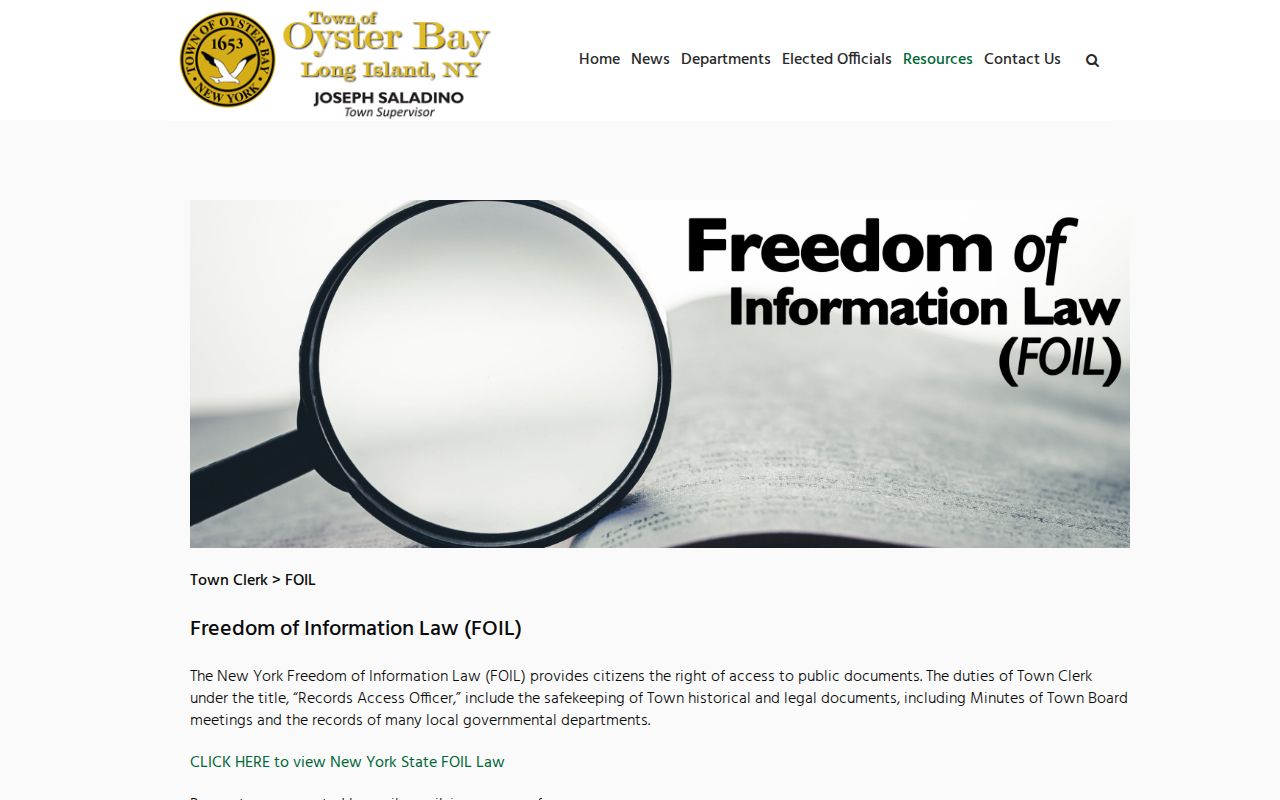
Under New York Freedom of Information Law, Public Officers Law Article 6, §§84–90, a reasonably described request is the fallback when an existing Town record is not posted online. An acknowledgement is generally due within five business days, and an agency must explain a later date and make it reasonably certain.
Oyster Bay Resident Lookup Limits
New York's Address Confidentiality Program, Executive Law §108 and 19 NYCRR Part 134, can provide a substitute address and mail forwarding for eligible protected participants. The actual address is confidential even though program participation is not necessarily confidential. Voter systems protect sensitive identifiers and protected addresses. Vital records have eligibility windows, and court files may be sealed or restricted. Do not attempt to reverse a substitute address through parcel, voter, court, or commercial sources.
If a source is wrong, keep its URL or record number, date, and supporting documentation, then ask the originating Clerk, court, Board of Elections, or registrar about correction, redaction, or sealing. A public record does not make broad republication of private details appropriate.